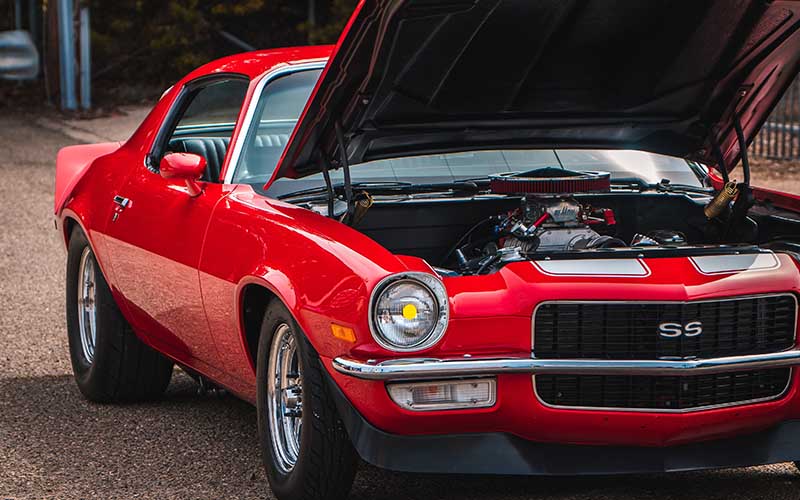
The Chevrolet Camaro has always been associated with performance, but one of the most interesting aspects of the modern Camaro is the variety of engines offered during its sixth-generation production run. Buyers could choose between a turbocharged four-cylinder, a naturally aspirated V6, and several V8 configurations. Each engine gives the Camaro a distinctly different character, making the choice about much more than simply horsepower.
The final sixth-generation Camaro, the 2024 model, was offered with a 3.6-liter V6, a 6.2-liter naturally aspirated V8, and a supercharged 6.2-liter V8. The turbocharged four-cylinder had been available earlier in the sixth-generation Camaro but was dropped for the final model year.
The 4-Cylinder Camaro: Lightweight and Efficient
The Camaro’s 2.0-liter turbocharged four-cylinder was the unconventional choice for an American muscle car. Rather than relying on large displacement, Chevrolet used turbocharging to produce strong performance from a relatively small engine.
The main advantage of the four-cylinder is efficiency. With fewer cylinders and a smaller displacement, it can consume less fuel during everyday driving than the larger engines, particularly when the driver is not demanding maximum performance. It also gives the Camaro a lighter front end, which can contribute to responsive handling.
However, the four-cylinder does not deliver the same effortless acceleration or soundtrack as the V6 and V8. For some buyers, that is a significant compromise. The Camaro may look like a traditional muscle car, but the four-cylinder version feels more like a modern sports coupe that happens to wear classic muscle-car styling.
For someone who wants the Camaro primarily as an affordable daily driver, the four-cylinder can make considerable sense. It provides enough performance to be entertaining without the fuel consumption and running costs associated with a V8.
The 6-Cylinder Camaro: The Middle Ground
The 3.6-liter V6 is arguably the most balanced engine in the Camaro lineup. In the 2024 Camaro, it produced 335 horsepower and 284 lb-ft of torque.
Compared with the four-cylinder, the V6 provides a more traditional performance-car experience. Power delivery is smooth and linear, and the naturally aspirated engine does not depend on a turbocharger to produce its power. It also has a distinctive V6 exhaust note that is considerably more aggressive than the four-cylinder’s sound.
At the same time, the V6 avoids many of the compromises associated with the larger V8. It is lighter and generally less demanding on fuel, while still providing enough power to make the Camaro genuinely quick.
The V6 is therefore an excellent choice for drivers who want a performance-oriented Camaro without paying for the maximum possible power. It is particularly attractive as an everyday sports car because it combines respectable acceleration, relatively reasonable operating costs, and the Camaro’s rear-wheel-drive chassis.
The 8-Cylinder Camaro: The Classic Choice
For many enthusiasts, however, nothing replaces a V8. The Camaro’s 6.2-liter LT1 V8 produced 455 horsepower and 455 lb-ft of torque in the final-generation cars.
The V8 transforms the Camaro’s personality. Acceleration is stronger, throttle response feels immediate, and the engine produces the deep exhaust note that has become synonymous with American performance cars. The combination of large displacement, rear-wheel drive, and available manual transmission gives the V8 Camaro a character that the smaller engines simply cannot completely reproduce.
The V8 is also more than just a straight-line engine. The sixth-generation Camaro was developed around a sophisticated chassis, meaning the car can take advantage of its extra power on winding roads and racetracks as well as during acceleration.
At the top of the range was the Camaro ZL1, which used a supercharged 6.2-liter V8 producing 650 horsepower and 650 lb-ft of torque. This moves the Camaro into serious high-performance territory, where acceleration and track capability become the primary priorities.
Which Camaro Engine Is Best?
There is no single answer because each engine suits a different type of driver.
The four-cylinder is best for buyers who prioritize efficiency, lower running costs, and a lighter-feeling car while still wanting Camaro styling and rear-wheel-drive performance.
The V6 is arguably the best compromise. It provides substantially more performance than the four-cylinder while avoiding the fuel consumption and cost of a V8. For an enthusiast who plans to drive the Camaro every day, the V6 is a compelling option.
The V8, however, is the choice for buyers who want the complete traditional muscle-car experience. Its combination of power, torque, sound, and character is difficult to replicate with a smaller engine. The 455-horsepower LT1 already offers more than enough performance for most drivers, while the 650-horsepower ZL1 takes things to another level.
Ultimately, choosing between the Camaro’s four-, six-, and eight-cylinder engines comes down to priorities. The four-cylinder emphasizes efficiency, the V6 delivers balance, and the V8 emphasizes performance and emotion. That variety is one of the reasons the modern Camaro appealed to such a wide range of drivers. Even though the sixth-generation Camaro ended production after the 2024 model year, its different engine choices demonstrate how a single sports-car platform can deliver remarkably different driving experiences.